
Going viral isn't some random lottery. It's about psychology. If you want to create something that people can't help but share, you have to aim for a powerful emotional response right from the start. We're talking about content that hits you with a wave of awe, makes you laugh out loud, sparks a bit of anger, or makes you think, "That's so me."
Why People Smash the Share Button
Before you can create something shareable, you have to understand why people share anything at all. It's almost never a logical choice. It’s an impulse. Sharing is a gut reaction to something that connects with us on a deep, emotional level. It's how we signal our identity, connect with our tribe, and react to the world.
Virality is just that impulse happening millions of times over.
Think about it. The content that truly explodes online is almost always something that triggers a "high-arousal" emotion. These are the feelings that get our blood pumping and make us want to do something. Sharing is the easiest, quickest action we can take.
What was the last thing you shared online? I'll bet it made you genuinely laugh, feel a flash of injustice, or just sit back and say, "Wow." That's the engine of virality, and you can learn to build it.
The Four Horsemen of Shareability
Not all feelings are created equal in the sharing economy. Sadness, for instance, is powerful, but it often makes people turn inward. You want to focus on the active, intense emotions that practically demand to be passed along.
Here's a step-by-step guide to choosing and implementing the right emotion for your content:
- Awe and Wonder: To achieve this, showcase something extraordinary.
- Tutorial: Use a time-lapse feature on your phone to capture a sunset or a flower blooming.
- Example: Create a short video highlighting a mind-blowing scientific fact or a demonstration of incredible human talent, like a complex trick shot.
- Unexpected Humor: Laughter is a social glue, but it must be surprising.
- Tutorial: Record a common, relatable frustration (like assembling furniture). Use quick cuts to show the escalating struggle, then end with an unexpected twist or funny voiceover.
- Example: A video that starts like a serious makeup tutorial but quickly devolves into a hilarious, failed attempt.
- Righteous Anger or Injustice: This taps into a powerful need to act.
- Tutorial: Use screen recordings and text overlays to clearly and concisely expose a misleading claim or unfair practice. Keep it fact-based and direct.
- Example: A post comparing the advertised size of a fast-food item to the actual product received, highlighting the discrepancy.
- Deep Relatability: This is the "I feel seen" effect.
- Tutorial: Create a "Point of View" (POV) video. Film from your perspective doing something highly specific and common, like trying to quietly open a snack in the middle of the night.
- Example: A short clip with the text, "Me pretending to be on a work call to avoid talking to someone in public."
The real secret to making things go viral isn't about chasing algorithms. It's about understanding people. If you can make someone feel something powerful, you’ve created something worth sharing.
Making Emotion Work for Your Brand
Now, this isn't about randomly picking an emotion and running with it. The choice has to be strategic. A serious financial firm probably won’t build its brand on goofy memes, and a children's toy company should probably steer clear of righteous anger.
Here's a practical breakdown:
- Step 1: Identify Your Brand's Core Voice. Are you helpful, innovative, playful, or authoritative? Write down three adjectives that describe your brand.
- Step 2: Match Your Voice to an Emotion.
- If you're an innovative tech company, your voice aligns with Awe. Create content showing off what your products can do in a surprising way.
- If you're a pet supply brand, your voice is likely playful and caring, which aligns with Humor and Relatability. Film funny pet moments.
- Step 3: Brainstorm Concrete Ideas. For the tech company: a tutorial on a "hidden feature" that feels like magic. For the pet brand: a step-by-step guide on teaching your dog a funny, useless trick.
By intentionally building one of these high-arousal emotions into the core of your content, you stop guessing and start creating a repeatable framework for making things people actually want to share.
Your Blueprint for Crafting Shareable Video Content
Video isn't just part of the internet anymore; it's practically the main language. If you want your content to catch fire and spread, you have to get good at short-form video. It's that simple.
Consider this: video is on track to make up a staggering 82% of all internet traffic this year. On top of that, it has a 52% higher chance of being shared compared to other types of content. The potential is massive. If you want to dive deeper, these video marketing statistics really spell out the opportunity.
The good news? You don't need a fancy production studio. That smartphone in your pocket is more than capable of creating something that resonates with millions. The real secret isn't the gear—it's having a smart, repeatable strategy.
Hook Them in the First Three Seconds
Let's be real: people scroll endlessly. You have a tiny, brutal window—about three seconds—to give someone a reason to stop on your video. If your opening is weak, the rest of your hard work doesn't matter. The video is dead on arrival.
Here’s a step-by-step tutorial for creating a killer hook:
- Choose Your Hook Type:
- Provocative Question: "Are you making this common mistake?"
- Visual Shock: A surprising before-and-after shot.
- Bold Claim: "This is the only hack you'll ever need for..."
- Film the Hook First: Record a 3-5 second clip that delivers only the hook. For a question, look directly at the camera and ask it. For a visual, show the most dramatic part of the transformation right away.
- Add Text Overlay: Immediately add bold text on screen that repeats or reinforces the hook. Use a tool like CapCut or Instagram's native editor. Example text: "You're Cleaning This Wrong."
- Test It: Show the first 3 seconds to a friend. If they don't immediately ask "What happens next?", your hook isn't strong enough.
These aren't just tricks; they're pattern-interrupts. They break the hypnotic scroll and give your content a fighting chance.
This infographic breaks down some of the core ideas for grabbing that initial attention.
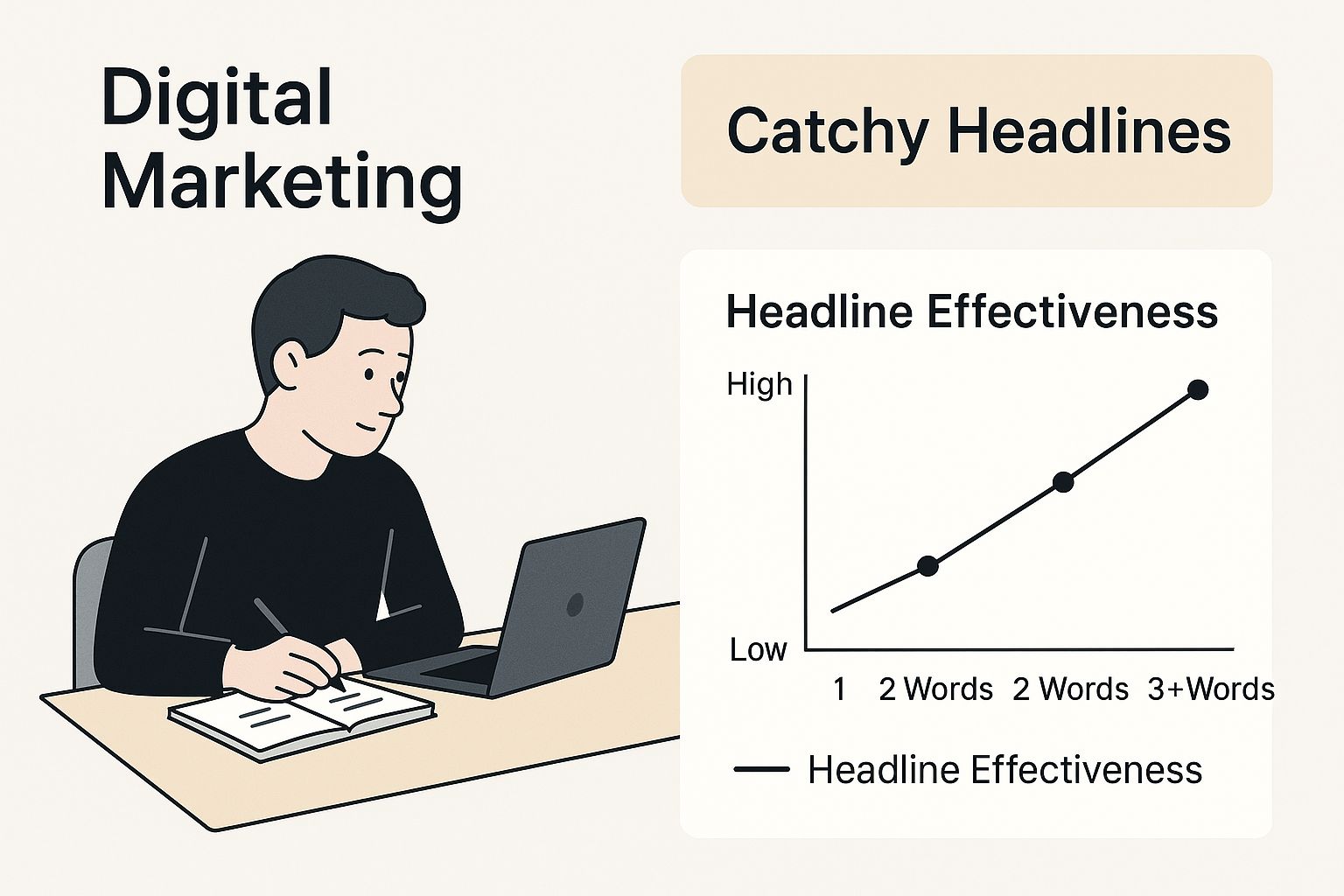
As you can see, a catchy opening is the foundation. It doesn't matter if it's a headline or the first frame of a video; its job is to stop the scroll.
Script for Pace and Punch
One of the biggest mistakes I see is people trying to cram a 10-minute presentation into a 30-second clip. It never works. The best viral videos are almost always built around a single, focused idea. Your script needs to be ruthless in cutting out anything that doesn't serve that one core message.
Here’s a simple 3-step scripting tutorial:
- The Hook (1 sentence): Write down the one sentence that grabs attention. Example: "Stop throwing away your stale bread; do this instead."
- The Core Value (3 bullet points): List the three essential steps of your tutorial or main points of your story.
- Cut bread into cubes.
- Toss with olive oil and spices.
- Air fry for 10 minutes.
- The Payoff (1 sentence): Write a concluding sentence that shows the result or includes a call-to-action. Example: "Now you have perfect, crunchy croutons. Follow for more kitchen hacks."
When you write, keep your sentences short and conversational. Write it like you’d say it to a friend, not like you're drafting a business proposal. This makes your content feel way more authentic and is much easier to digest on platforms like TikTok and Reels.
Pro Tip: Always read your script out loud. If it feels clunky or you trip over your words, it’s too complicated. Simplify it until it rolls off the tongue.
Edit for Maximum Watch Time
Editing is where the magic really happens. This is where you inject energy and momentum to keep viewers glued to the screen. Your primary goal is to chop out any moment of dead air or slow pacing that might tempt someone to swipe away.
A practical editing workflow:
- Make Aggressive Jump Cuts: Film your video. In an editor like CapCut, go through and cut out every single breath or pause between words. This creates a fast, energetic pace.
- Add Text Overlays: Add captions that appear on screen as you say the words. This keeps the viewer's eyes moving and engaged.
- Incorporate Trending Audio: Go to the TikTok or Instagram Reels audio library. Find a trending sound and lower its volume to 5-10%, so it sits behind your voiceover, adding a layer of relevance without being distracting.
- Add Captions: Use the auto-caption feature in your editing app. A huge number of people watch videos with the sound off. This is a non-negotiable step for accessibility and watch time.
Key Elements of Viral Video Content
This table summarizes the essential ingredients that our data shows consistently contribute to higher audience engagement and shareability.
| Element | Description | Example Tactic |
|---|---|---|
| Strong Hook | An opening that grabs attention within the first 1-3 seconds. | Start with a surprising statistic, a controversial question, or a visually jarring clip. |
| Emotional Arc | The video evokes a strong emotion—humor, awe, surprise, or empathy. | A relatable "everyday struggle" clip that ends with a hilarious outcome. |
| Relatability | The content reflects a common experience, thought, or problem. | "POV: You're trying to work from home with a toddler." |
| High Value | It provides a useful tip, a clever hack, or insightful information. | A 15-second video showing how to peel a garlic clove in 5 seconds. |
| Clear Payoff | The video delivers on the promise made in the hook, leading to a satisfying end. | After showing a messy room, the final shot is a satisfying "after" transformation. |
| Shareable CTA | An implicit or explicit prompt to share, like "Send this to someone who needs to see it." | A funny pet video with the text overlay, "Tag a friend who acts like this." |
Focusing on these elements doesn't guarantee a video will go viral, but it dramatically improves your odds by aligning your content with what audiences are already proven to love and share.
Using Creator Partnerships to Spark Virality
Sometimes, even the most amazing content needs a little nudge to find its audience. This is where creator partnerships become your secret weapon, acting as the perfect catalyst to get the ball rolling.
I'm not talking about shelling out huge checks for a generic celebrity endorsement. The real magic happens when you build genuine relationships with creators who have already earned the trust of a dedicated community.
The creator economy is no longer just a trend; it's a massive shift in how people find and trust information. The influencer marketing industry has absolutely skyrocketed, jumping from $1.4 billion in 2014 to a projected $32.55 billion in 2025. You can dig into the numbers yourself in this detailed industry report.
This growth spells it out clearly: brands win when they team up with creators who make authentic, relatable stuff. Tapping into this can seriously fast-track your content's journey to going viral.
Finding Your Perfect Creator Match
Forget about chasing creators with millions of followers. Your most powerful collaborations will often come from micro-creators (10,000 to 100,000 followers) and even nano-creators (1,000 to 10,000 followers). Their audiences might be smaller, but they are incredibly engaged and fiercely loyal.
Here's a step-by-step tutorial to find them:
- Hashtag Hunting: On Instagram or TikTok, search for a specific hashtag relevant to your niche (e.g., #sustainablefashiontips).
- Filter by "Recent": Ignore the "Top" posts for now. Scroll through the "Recent" tab to find creators who are actively posting, not just those who went viral once.
- Check the Comments: Open a few posts. Are people having real conversations? Or is it just fire emojis? Look for genuine community engagement. This is a sign of a loyal audience.
- Analyze Their Vibe: Does their content style and tone of voice match your brand? A good partner is someone who is genuinely fired up about your subject area. Their enthusiasm will feel real because it is real.
Crafting a Pitch That Gets a "Yes"
Once you have a shortlist of potential partners, you need to make your outreach count. Creators get absolutely flooded with generic, copy-paste requests. Here’s a template for a personalized pitch that works:
Subject: Loved your [specific video topic] video! Collab idea?
Body:
Hi [Creator's Name],
Just watched your video on [mention a specific video, e.g., "how to style vintage jackets"] and loved the tip about [mention a specific detail, e.g., "pairing them with modern sneakers"]. It was so clever!
My name is [Your Name] from [Your Brand], where we [one-sentence description of what you do]. Since your audience is clearly passionate about [their audience's interest], I thought a collaboration would be a perfect fit.
I have a rough idea for a video on [your collaborative idea], but I'd love to hear your creative spin on it. We believe in giving creators full freedom to make something amazing for their community.
Let me know if you're open to chatting more!
Best, [Your Name]
The goal isn't to "use" a creator's audience. It's to co-create something so good that their community can't help but share it, sparking that first crucial wave of virality.
Building the partnership around co-creation is the key. You could brainstorm ideas together based on what's trending. For a little inspiration, our guide on 40 practical TikTok content ideas to go viral in 2025 is a great place to start your collaborative sessions.
When you give creators the freedom to weave your message into their own style, the final product feels less like an ad and more like a trusted recommendation from a friend.
Using AI and Data to Predict Viral Trends
Relying on luck to go viral just doesn't cut it anymore. The game has totally shifted. Now, it’s all about a more calculated approach where data and artificial intelligence give you a serious edge. Instead of just throwing ideas at the wall and hoping something sticks, you can analyze real-time information to make much smarter moves.
This is about moving beyond simple brainstorming sessions and diving into predictive analysis. With the right tools, you can spot emerging trends, hot topics, and even trending audio clips before they blow up, giving you a massive first-mover advantage.
Tapping into Social Listening Platforms
Think of social listening tools as your digital crystal ball. They’re constantly scanning social media, forums, and blogs to pick up on conversations and topics that are just starting to gain momentum. Here's a practical, step-by-step way to use this data:
- Set Up Keyword Tracking: Use a tool (even Google Alerts for a free option) to monitor keywords and phrases in your niche. Track your brand, your competitors, and key industry terms.
- Identify Recurring Questions: Scan the results for questions that pop up repeatedly. For example, if you sell skincare, you might see "how to fix cakey foundation" appearing constantly.
- Create "Answer" Content: Your next piece of content is a direct answer to that question. A tutorial video titled "3 Steps to Stop Your Foundation from Ever Looking Cakey Again" is practically guaranteed to get attention because you already know people are searching for the solution.
This data is an absolute goldmine for content ideas that are almost guaranteed to resonate—because you already know the audience is talking about them.
Using Generative AI to Craft and Test Hooks
Generative AI is way more than a simple idea machine; it's a powerhouse for rapid-fire experimentation. Here's a tutorial for using AI to find the perfect hook:
- Write a Simple Prompt: Go to your favorite AI chatbot and write: "My video is a tutorial on how to make coffee at home that tastes better than a cafe's. Give me 10 scroll-stopping hooks (under 10 words each) for a TikTok video about it."
- Review and Refine: The AI will generate a list like:
- "Your coffee is bad. Here's why."
- "The #1 mistake you're making with coffee."
- "This 30-second trick beats any barista."
- A/B Test the Best Options: Don't just pick one. Create two or three versions of your video with different hooks. Post them a day apart and see which one gets the best engagement in the first hour. Double down on the winning style for future content.
You can even use AI to create stunning visuals that stop the scroll. Our guide on artificial intelligence in photography, for example, gets into how you can generate completely unique images that capture your audience's eye. This speed means you can pivot based on real-time feedback instead of being stuck with a single idea that might not even work.
The real power of AI isn't just about creating content faster. It's the ability to test, learn, and adapt at a speed that was once impossible, dramatically shortening the feedback loop between you and your audience.
The results of this approach are already showing. By 2025, around 90% of businesses using generative AI are reporting significant time savings. Better yet, 73% see real increases in engagement when they use AI-assisted strategies. As you can see from these powerful social media insights, this tech helps creators produce more compelling content, personalize their messaging, and analyze feedback to constantly get better.
Strategic Promotion for Maximum Momentum

Let's be honest, creating a fantastic piece of content is only half the battle. If no one sees it, did it even really happen? That first big promotional push is what separates a potential hit from a guaranteed flop. It's all about giving your content the initial velocity it needs to break free and go viral.
This isn't about just spamming your links across the internet. It’s about a calculated launch, a plan to get your work in front of the right eyeballs at exactly the right time. A solid promotion strategy is the engine that drives momentum, turning those first few shares into a self-sustaining chain reaction.
Master Platform-Specific Timing and Tactics
Every social media platform has its own unique rhythm. Posting when your audience is most active can make a night-and-day difference in your initial engagement. But it's more than just timing.
Here is a practical tutorial for a powerful hashtag strategy:
- Find Your Tags:
- Broad Appeal (1-2 tags): Search a general term like #contentcreation. Find tags with over 1 million posts.
- Niche-Specific (3-5 tags): Search a more specific term like #videomarketingtips. Find tags with 50k-500k posts. These are your community hubs.
- Content-Specific (2-3 tags): Create tags that describe the video itself, like #hookwriting or #editingtutorial.
- Create a "Hashtag Set": Save this mix of 8-10 tags in a notes app on your phone.
- Apply at Posting: When you post your video, copy and paste this set into the description. This balanced approach helps you reach a broad audience while also hitting the core group of people most likely to care about your message.
For a deeper dive, learning how to increase Instagram followers organically offers some powerful, platform-specific growth tactics that can be adapted elsewhere.
Drive Community-Powered Promotion
Your most powerful advocates are often found in communities that already know and trust you. But here's the catch: just dropping a link into a niche Reddit or Facebook group is a surefire way to get yourself banned. You have to be a genuine member first.
Here's a step-by-step guide to sharing without being spammy:
- Engage First, Post Later: For a week before you post, become an active member of a relevant subreddit or Facebook group. Answer questions and comment on other people's posts.
- Frame Your Post as a Question: When you share your content, don't just drop the link. Start a conversation.
- Bad Post: "Check out my new video on productivity hacks!"
- Good Post: "I made a short video breaking down a new workflow that's saved me 5 hours a week. I'm curious, what's the one productivity hack you can't live without? Happy to share mine in the comments."
- Share the Link in the Comments: When someone asks, or after the conversation gets going, drop the link as a reply. This makes it feel like a helpful contribution, not self-promotion.
The goal isn't just to drop a link; it's to start a conversation. Frame your post with a question related to your content. This invites interaction and makes your post feel like a real contribution, not just blatant self-promotion.
The Art of Content Repurposing
One great piece of content can have many lives. Repurposing is the ultimate way to stretch the reach and lifespan of your best stuff. That one viral video doesn't have to fade away after 24 hours.
Here's a simple repurposing tutorial:
- Identify Your "Pillar" Content: This is your best-performing video.
- Extract Key Moments: Watch the video and pull out 3-5 key tips, quotes, or data points.
- Create "Micro" Content:
- Instagram Carousel: Use a simple tool like Canva. Create one slide for each key tip you extracted. Use a bold visual and minimal text.
- Tweet Thread: Write an engaging opening tweet (your hook). Then, reply to it with each key point as a separate tweet, creating a thread.
- Short Blog Post: Copy the auto-generated captions from your video into a document. Clean them up, add headings for each key point, and embed the original video at the end. You now have a blog post.
By strategically repackaging your content, you can hit completely new audiences who hang out on different platforms or prefer different formats. It’s the smartest way to maximize every bit of effort you poured into the original creation.
Common Questions About Creating Viral Content
Even with a solid plan, trying to create viral content can feel like a total crapshoot. It's easy to get frustrated when you're pouring your heart and soul into your work and just... crickets. Let's dig into some of the questions that pop up when things don't go nuclear right away.
One of the big ones is, "Why did my content flop?" Most of the time, the answer is in a tiny detail you overlooked. Maybe you nailed the emotional core but the hook didn't grab people in the first 3 seconds. Or maybe your promotion strategy was solid, but it never reached that initial, critical group of people who would have shared it. Think of every "flop" as a free lesson.
How Long Does It Take to Go Viral
Honestly, there’s no magic number here. Some content catches fire and explodes within hours. Other pieces are "sleeper hits," slowly gaining steam for weeks before suddenly taking off. We've all seen videos hit over five million views in their first week, but that's like winning the lottery—it's the exception, not something you can bank on.
A much healthier (and more effective) mindset is to focus on steady, consistent growth. Your real goal isn't just one viral hit; it's to build a whole library of awesome content that keeps your audience coming back. Virality is usually just the happy accident that comes from showing up consistently.
The biggest mistake I see people make is giving up way too soon. Every single piece of content, especially the ones that don't perform well, is teaching you exactly what your audience wants to see.
Is Going Viral Just Luck
Look, a little bit of luck never hurts. But banking on it isn't a strategy. Engineering viral content is all about tipping the scales in your favor. It’s a deliberate process that involves getting inside people's heads, looking at what's already working, telling a killer story, and then getting it in front of the right eyeballs.
Here's a practical step-by-step comparison:
- Luck: A random, shaky video of a cat falling off a table somehow gets a million views. There's no lesson to learn and no way to repeat it.
- Strategy:
- You notice that "relatable pet owner struggles" is a trending content format.
- You script a 15-second video: Hook ("My cat is a paid actor"), Core (show the cat knocking something over in a funny way), Payoff (a funny caption).
- You use a trending audio clip that fits the mood.
- You post it with a mix of broad (#catsofinstagram) and niche (#catmemes) hashtags.
That second approach? You can do that again and again. You’re actively setting the stage for success instead of just crossing your fingers. Your job is to make your content so good and so perfectly placed that it's ready to ignite the second the opportunity appears.
Ready to create stunning visuals that stop the scroll and boost your chances of going viral? With AI Photo HQ, you can generate thousands of unique, high-quality images in any style imaginable, from realistic photoshoots to eye-catching fantasy art. Give your content the visual edge it needs to stand out. Explore our creative tools and start your first project today at https://aiphotohq.com.


