Forget stuffy studio sessions and coordinating everyone's outfits. There’s a new, wildly creative way to capture your family’s spirit: the AI family portrait. This guide provides step-by-step instructions to create fun, artistic, and one-of-a-kind keepsakes.
Think of it this way: you can generate a unique image of your loved ones in literally any style imaginable. Ever wanted to see your family as classic oil painting subjects, whimsical cartoon characters, or adventurers in a fantasy world? Now you can.
A New Way to Picture Your Family
Generative AI is completely changing how we think about this timeless tradition. It puts the creative power right in your hands, letting you produce stunning, personalized artwork that truly reflects your family’s unique personality and imagination.
Imagine your kids as superheroes saving the city, or picture the whole family rendered in the dramatic, moody style of a Renaissance master. This is the kind of creative freedom we’re talking about—something that’s just not possible with a camera alone.
More Than Just a Fun Trend
This shift toward AI-powered art is way more than a gimmick; it's a massive and rapidly growing movement. The AI image generation market is exploding, projected to jump from $8.7 billion in 2024 to an incredible $60.8 billion by 2030.
This explosive growth is happening for a few key reasons:
- It’s for everyone: Powerful art creation tools that once belonged to professional designers are now accessible to anyone with a computer.
- Deeply personal: You can customize portraits to reflect inside jokes, shared hobbies, or favorite fictional worlds.
- Boundless creativity: Your imagination is the only real constraint. You can create styles that are literally impossible to capture in the real world.
As AI continues to get better and more integrated into our lives, it's worth keeping an eye on the future trajectory of AI in digital trends to see just how much these tools will reshape our creative outlets.
Choosing the Right AI Art Generator
Picking the right tool for your AI family portrait is easily the most important first step. The platform you decide on will shape everything—the style, how realistic it looks, and the final quality of the image. Think of each generator as an artist with its own unique personality and style.
The sheer volume of AI-generated art is mind-boggling. Platforms like Midjourney, DALL-E 3, and Stable Diffusion are cranking out millions of images every single day. Since 2022, a staggering 15 billion AI images have been created, which just goes to show how massive this creative shift has become.
This decision tree helps visualize the choice you're making between a classic photoshoot and an AI-powered portrait.
The graphic really simplifies that fork in the road, positioning AI as a legitimate and exciting new way to capture family memories.
Top Contenders for Family Portraits
So, where should you start? Let's break down the main players. Each has its own strengths, and the best one for you really depends on what you're trying to achieve.
Midjourney is the go-to for many because of its incredible artistic flair and cinematic quality. It's brilliant at creating painterly, stylized portraits with gorgeous textures and dramatic lighting. If you're aiming for something more fantastical or illustrative, Midjourney is probably your best bet.
DALL-E 3 is built right into tools like ChatGPT Plus, which makes it incredibly easy to get started. It's known for understanding natural language prompts with surprising accuracy. If you're new to AI art and just want to jump in without a steep learning curve, DALL-E 3 is a fantastic starting point.
Stable Diffusion is the power user's choice. It offers the most control, but you'll have to put in the time to learn it. It’s perfect if you're the type who wants to tweak every little detail, from specific facial features to background elements. Just be prepared for a bit more of a technical journey.
AI Portrait Generator Feature Comparison
To make the choice a little clearer, here’s a quick side-by-side look at how these tools stack up for creating family portraits.
| AI Generator | Best For | Ease of Use | Realism Level | Artistic Flexibility |
|---|---|---|---|---|
| Midjourney | Highly artistic, cinematic portraits | Moderate | High, but stylized | Very High |
| DALL-E 3 | Beginners and easy prompt-to-image | Very Easy | High | Moderate |
| Stable Diffusion | Ultimate control and customization | Difficult | Very High | Extremely High |
Ultimately, your choice boils down to a trade-off: are you looking for artistic results right out of the box, or do you want to get your hands dirty and control every last pixel?
To get a better sense of how these platforms work their magic, it can be helpful to understand the mechanics behind AI content generator tools. And for a really deep dive into how two of the biggest names compare, check out our comparison between Stable Diffusion and Midjourney.
How to Write Prompts That Bring Your Vision to Life
The real magic behind a memorable AI family portrait isn't the software—it's the prompt you feed it. You have to think of your prompt less like a simple command and more like a detailed creative brief you'd hand to a digital artist.
Throwing a vague request like "happy family portrait" at the AI will almost always give you a generic, cookie-cutter result. It just doesn't have enough to work with.
To craft something truly special, you need to "speak" the AI's language by layering in the details. It's all about breaking down your vision into specific building blocks, much like a painter or photographer would before starting their work. We'll show you how to build prompts that capture the genuine spirit of your family.
Building Blocks of a Great Portrait Prompt
A really effective prompt guides the AI on four key pillars: the subjects, the environment, the artistic style, and the overall mood. When you combine these elements, you transform a simple idea into a rich, visual story. Let's build one step-by-step.
Step 1: Describe the Subjects
Don't just say "a family of four." Get specific.
- Specify relationships and ages: "A father in his 40s, a mother in her late 30s, a 10-year-old son, and a 6-year-old daughter." This immediately gives the AI more context to create a believable scene.
- Describe interactions: Instead of just listing people, describe what they’re doing. "The family is laughing together on a porch swing" is so much more powerful than "a happy family." This small shift tells the AI to generate connection and emotion.
- Include key features (sparingly): You can add small details like "the father has a short beard" or "the daughter has long, curly brown hair." Be careful not to overdo it, as too many facial demands can confuse the AI.
Step 2: Set the Scene (Environment)
Next up, you need to set the stage. Where is this all happening?
Pro Tip: The environment is your best tool for storytelling. A "cozy living room with a fireplace" instantly creates a warm, intimate feeling. On the other hand, a "sun-drenched meadow with wildflowers" suggests adventure and freedom. Don't be afraid to be descriptive.
Step 3: Define the Artistic Style and Mood
Once you've locked down the who and the where, it’s time for the how. This is where you inject style and mood into your AI family portrait. Think about the artistic medium, the lighting, and the composition.
- Artistic Medium: Clearly state the style you're going for. Do you picture a "classic oil painting with visible brushstrokes," a "whimsical watercolor illustration," or maybe a "hyperrealistic digital photograph"?
- Lighting: Lighting controls the entire mood of the image. "Soft morning light filtering through a window" feels gentle and serene. In contrast, "dramatic golden hour lighting" produces those warm, almost cinematic tones.
- Composition: Guide the AI on how to frame the picture. Using phrases like "full-body portrait," "close-up shot focusing on their faces," or "wide-angle view of the family in a landscape" gives you much more control.
Practical Prompt Example:
Let's combine these steps into a complete prompt.
Goal: A warm, painted portrait of a family.
Final Prompt:Full-body portrait of a family of four laughing on a porch swing. A father in his 40s with a beard, a mother in her late 30s, a 10-year-old son, and a 6-year-old daughter with curly brown hair. They are on the wooden porch of a rustic cabin, surrounded by autumn trees. The style is a classic oil painting with visible, textured brushstrokes. The scene is illuminated by warm, golden hour lighting, creating a nostalgic and joyful mood.
Getting the hang of these details is the core of great prompt engineering. If you want to dive even deeper, our full guide on how to write AI prompts covers more advanced techniques.
Refining and Perfecting Your AI Portrait
Rarely does the AI nail the perfect shot on the first try. It’s best to think of that initial image as a creative starting point—a promising but often flawed draft. The real magic happens in the refinement process, turning that rough output into a polished masterpiece.
Your first attempt at an AI family portrait will almost certainly have some quirks. You might notice slightly distorted faces, a weirdly placed extra finger, or something in the background that just feels off. This is totally normal. Let's fix it.
Step-by-Step Troubleshooting
Problem 1: Distorted Faces or Extra Fingers
This is the most common issue. The fix is a negative prompt.
- Take your original prompt.
- At the end, add
--nofollowed by a list of things to exclude. - Example: Add
--no extra limbs, distorted faces, poorly drawn handsto your prompt. Rerunning it with this instruction will often clean up the result significantly.
Problem 2: Unwanted Objects or People
Let’s say you’re trying to generate a family on a beach, but the AI keeps adding random strangers.
- Identify the unwanted element (e.g., crowds).
- Add a negative prompt to exclude it.
- Example: Add
--no crowds, other peopleto solve that problem instantly.
Problem 3: The Pose Isn't Quite Right
If the interaction is wrong (e.g., a "family holding hands" prompt results in a tangle of arms), get more specific.
- Rewrite the action part of your prompt with more detail.
- Instead of: "family holding hands"
- Try: "father holding daughter's hand, mother holding son's hand." This gives the AI clearer instructions.
The goal here is iteration, not starting over from scratch every time. Each small tweak gets you closer to the perfect portrait. Find a result you almost love? Use it as a seed image and refine your prompt to build on what’s already working.
Advanced Editing with Inpainting and Outpainting
For fixes that require a more delicate touch, inpainting and outpainting are indispensable tools. You'll find these features in more advanced AI image editors.
How to Use Inpainting (Fixing a Smile):
- Upload your generated portrait to an editor with inpainting.
- Use the masking tool to select just the area you want to fix (e.g., a child's mouth).
- In the prompt box for the masked area, type a new, targeted instruction like "a happy, natural smile."
- The AI will regenerate only that spot, leaving the rest of the image untouched.
How to Use Outpainting (Expanding the Scene):
- Load your image into an editor with outpainting.
- Select the option to expand the canvas.
- Describe what you want to add to the new area in the prompt box (e.g., "more of the scenic meadow and blue sky").
- The AI will extend the background, creating a wider, more balanced scene for your AI family portrait.
Bringing Your Digital Portrait Into The Real World
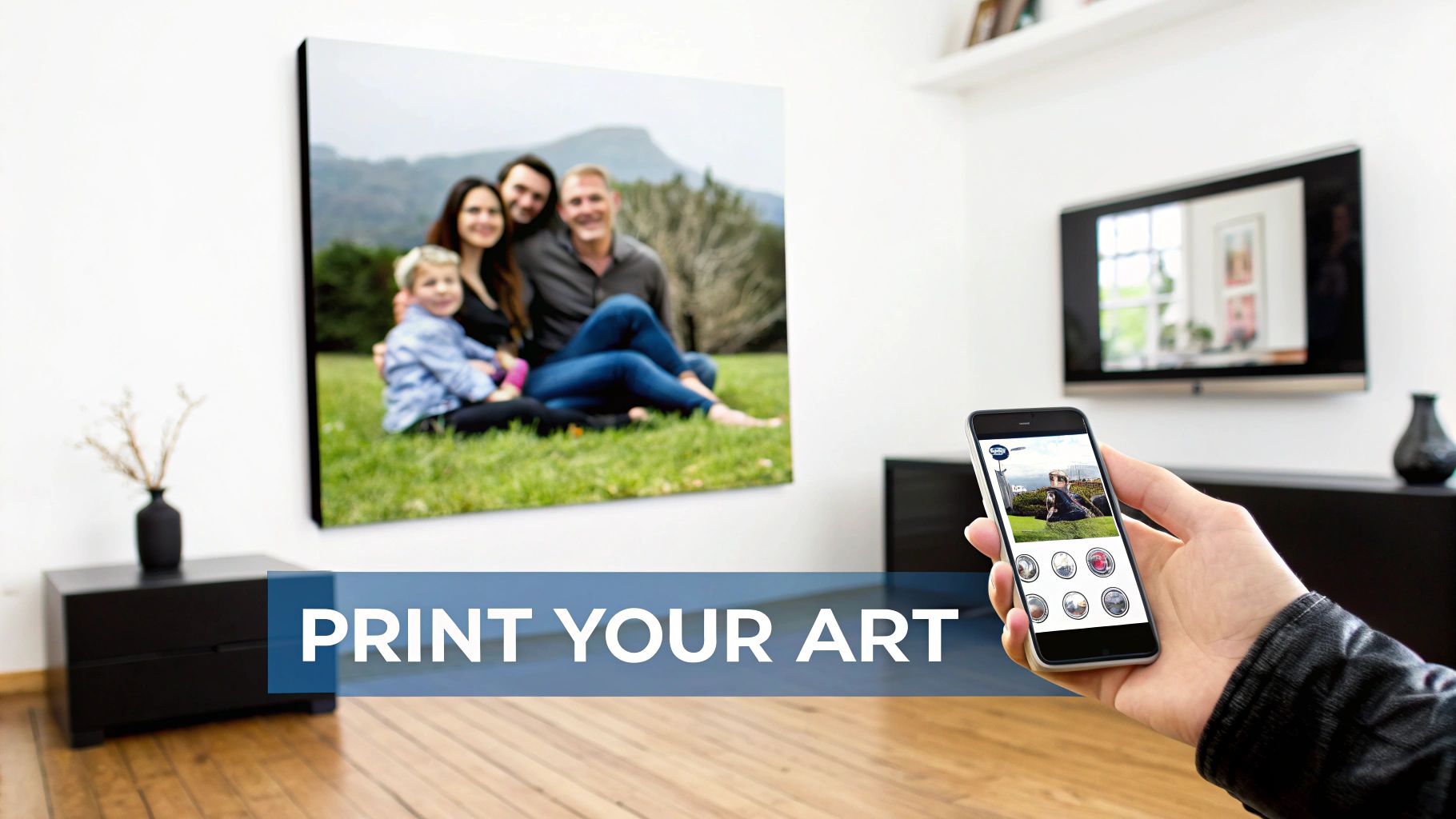
Okay, you’ve put in the work and created a digital masterpiece. The final, and arguably most rewarding, step is to bring that creation off the screen and into your life. An AI family portrait isn't just a file; it's a sentimental keepsake waiting to happen.
The very first thing you need to eyeball is the image resolution. Most AI generators create images that look great on a screen but may not be high enough quality for a physical print. A low-res file is the fastest way to get a blurry, pixelated photo.
For a sharp, professional-looking print, you need to be thinking about DPI (dots per inch). The magic number here is at least 300 DPI.
Getting Your Portrait Print-Ready: A 3-Step Guide
Step 1: Check Your Image Resolution
Download your final image. Right-click the file, go to "Properties" (on Windows) or "Get Info" (on Mac), and look at the "Details" or "More Info" tab. Check the dimensions in pixels. A small image (e.g., 1024x1024 pixels) might only print clearly at a small size like 3x3 inches.
Step 2: Upscale if Necessary
If your resolution is too low for your desired print size, don't panic. Use an AI upscaler.
- Go to an online AI upscaler service.
- Upload your AI family portrait.
- Select an upscale factor (e.g., 2x or 4x). A 4x upscale on a 1024x1024 image creates a 4096x4096 file, which is large enough for a quality 12x12 inch print.
- Download the new, high-resolution file.
If you want to dive deeper, you can learn more about how to use an online image upscaler to prep your file perfectly.
Step 3: Choose Your Physical Product
Once your image is properly scaled, the fun really begins. What will you turn it into?
- Classic Canvas Prints: Upload your high-res file to a print-on-demand service and select a canvas option.
- Framed Photos: Send the file to a photo printing service (online or local) and choose your print size and frame.
- Personalized Gifts: Use sites like Zazzle or Shutterfly to put your portrait on coffee mugs, phone cases, or one-of-a-kind holiday cards.
By sharing your AI portrait, you're also part of a massive cultural shift. The global market for family photography services is set to rocket to $21,850 million in 2025. A big part of that growth is driven by our desire to share unique family moments—and AI is opening up a whole new way to do it. You can see more on this growing market on archivemarketresearch.com.
Jumping into the world of AI family portraits, you’re bound to have a few questions. It’s a fun mix of creative vision and new tech, and figuring out a few key things upfront can save you a lot of trial-and-error.
Common Questions About AI Family Portraits
One of the biggest questions I hear is about likeness. Can an AI really capture my family members' faces? The answer is a little complicated. While the AI is brilliant at nailing specific art styles and general features, it doesn't actually know what your family looks like. It’s creating brand-new faces based on your descriptions. The trick is to focus on capturing the essence and spirit of each person, not a perfect, photo-realistic copy.
Legal and Ethical Considerations
Another hot topic is what you can legally do with these images. Can you print your AI family portrait and hang it on the wall or send it out on holiday cards? For the most part, yes. The images you generate are almost always yours for personal, non-commercial use. Still, it's smart to quickly check the terms of service for whatever AI tool you're using, just to be sure.
The rule of thumb is pretty simple: if it's for a personal keepsake, you're in the clear. The lines only get blurry if you try to sell the artwork commercially.
Finally, what about the cost? It's a valid concern. While some high-end, professional tools come with a subscription, many of the best platforms offer free trials or a starting batch of credits. This means you can experiment and create a beautiful portrait without spending a dime, making it easy for anyone to give it a try.
Ready to create a stunning, one-of-a-kind portrait of your own family? AI Photo HQ provides all the tools you need to bring your vision to life, from easy-to-use templates to advanced restoration features. Start creating your masterpiece today.


